How Long Does It Take to Ship a Car in 2026?


People ask this question expecting a number. The honest answer is: it depends on five things that most companies don't explain clearly upfront, and that gap between expectation and reality is where most of the frustration in auto transport comes from.
This guide gives you the real timeline, the real variables, and the questions worth asking before you book.
What Actually Determines How Long Car Shipping Takes?
Before quoting any numbers, it's worth understanding what drives the timeline, because two shipments of identical distance can take very different amounts of time based on conditions that have nothing to do with how fast a truck drives.
Distance
The most obvious factor, but not always the most decisive one. A 300-mile regional move falls within the 0–500 mile range and typically takes 1 day in transit. A 2,800-mile cross-country shipment falls within the 2,500–3,000 mile range and typically takes 7–9 days in transit (see the full transit-time table below).
Carriers average 400–500 miles per day under normal conditions, with federal regulations capping driving time at 11 hours per day, but the transit-time ranges below also account for required rest periods, weekends, and multi-stop routing, which is why actual transit days run higher than distance divided by daily mileage alone would suggest.
Route Demand and Carrier Availability
This is the variable that surprises most first-time shippers. Auto transport operates through a national load board, carriers bid on available routes based on profitability and routing efficiency. High-volume corridors like Texas to Florida or California to New York have dense carrier activity, which means faster pickup. Less-traveled routes between secondary cities can sit longer before a carrier bids on them, regardless of distance.
Pickup Location: Urban vs. Rural
Major metro areas generate more carrier traffic, which means faster matching. A pickup in Austin, Dallas, or Houston will typically move faster than the same shipment originating from a smaller city or rural area. If you're in a secondary location, some brokers will arrange terminal pickup at the nearest major hub, worth asking about if your timeline is tight.
Season and Timing
Auto transport is seasonal. The industry's peak runs from roughly March through early October, with summer being the busiest period. More demand means more carriers active on popular routes, but also higher prices and occasionally longer waits if capacity tightens. Late fall and winter generally offer faster availability on many routes and more competitive pricing, though some corridors thin out during the off-season.
Vehicle Type and Condition
A standard, operable sedan is the easiest load for any carrier to handle. Inoperable vehicles require specialized equipment, a winch-equipped carrier, which narrows the pool of available trucks and adds time. Oversized vehicles like lifted trucks or modified cars may also face longer wait times depending on carrier capacity.
Transit Time, Pickup Window, and Total Time by Distance
These figures reflect our internal planning guidelines at Flix Auto Transport. Below are realistic ranges under standard conditions with a single-driver, open-transport carrier. Transit time is counted in calendar days, including weekends, from the moment the vehicle is loaded.
Note: Pickup window is counted in business days, from booking to the day the carrier actually arrives, not from booking to delivery.
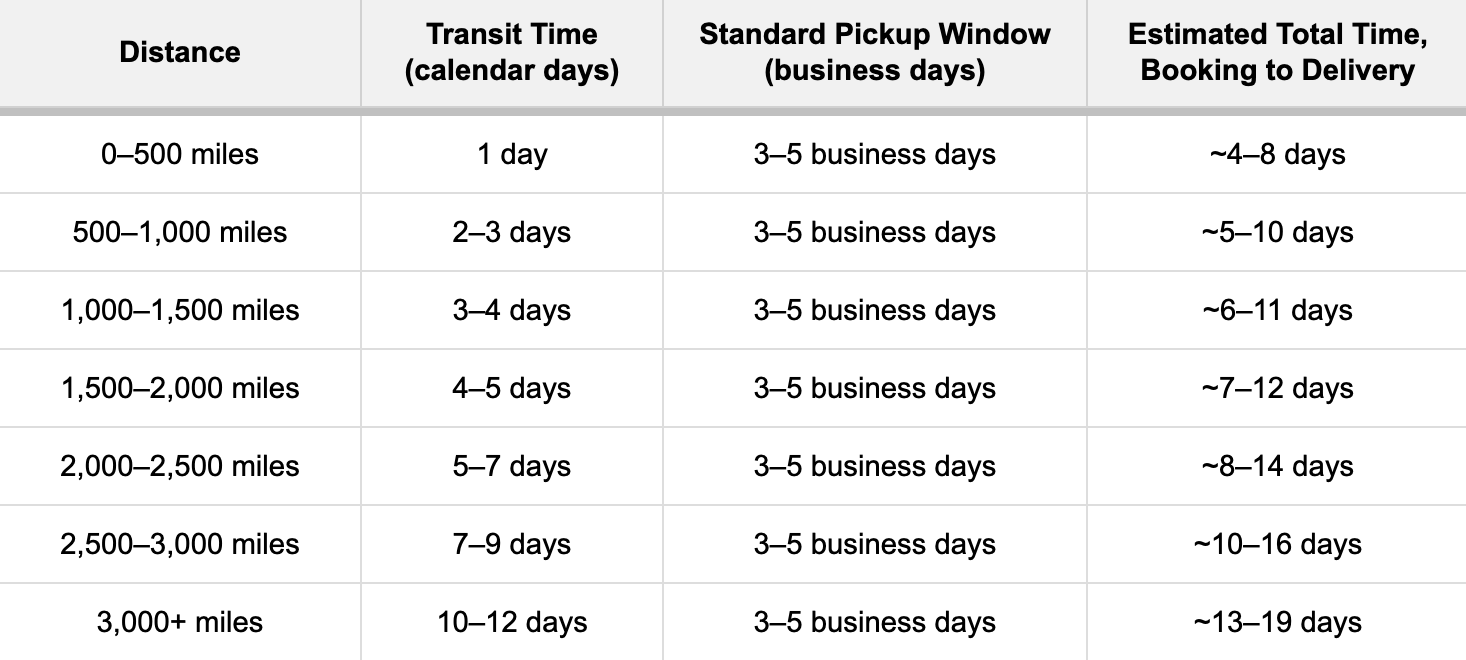
Pickup windows generally fall into three categories:
- Standard pickup window: a minimum of 3 business days, typically 3–5 business days on major routes. A 5-business-day window means the carrier can arrive on any one of those 5 days, not necessarily the last one.
- Expedited pickup: an exact requested date, or pickup within 24 hours. This comes at a premium and depends on carrier availability for your specific route.
- Flexible pickup window: more than 5 business days. This generally gives dispatch more carrier options to work with, and sometimes results in better pricing.
The total-time column above assumes a standard pickup window. Expedited pickup will shorten total time; a flexible window may lengthen it, though often at a lower cost.
How Long Does It Take to Ship a Car? Timeline by Distance
These are realistic estimates under standard conditions using open transport. They are windows, not guarantees, and the pickup period is separate from transit time (more on that below).
- Under 500 miles (regional moves) Transit time: 1–3 days. Routes between major cities in the same region, Austin to Houston, Dallas to San Antonio, move quickly. Carrier availability is high, routes are well-traveled, and short hauls are easy to slot into existing carrier routes.
- 500–1,000 miles (mid-range) Transit time: 2–5 days. Think Texas to Tennessee, or Arizona to Colorado. These routes have solid carrier coverage but may involve one or two overnight stops depending on scheduling.
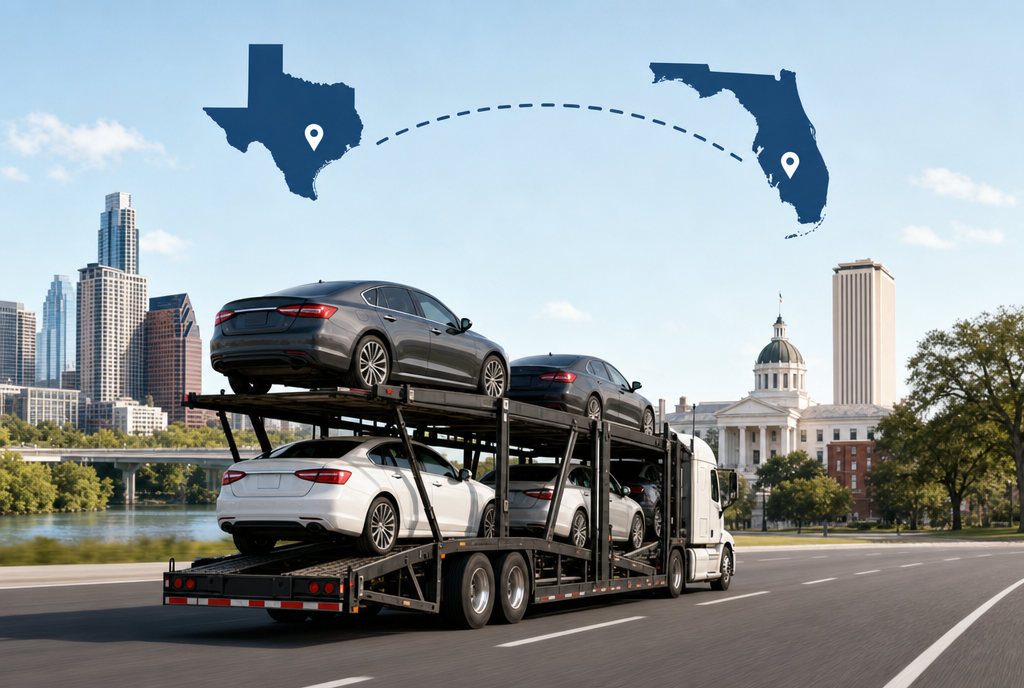
- 1,000–2,000 miles (long-haul) Transit time: 4–7 days. Cross-regional moves in this range, Texas to Florida, or the Midwest to the Southeast, are well-covered corridors. Timing is predictable on most routes, less so on off-peak corridors.
- 2,000+ miles (coast-to-coast) Transit time: 7–10 days. Texas to California, or New York to the Pacific Northwest. These are the routes where planning ahead matters most, because pickup windows can stretch if the timing or carrier load isn't aligned.
Pickup Window vs. Transit Time: The Distinction Most People Miss
Understanding how long does it take to get a car shipped means understanding that the total timeline has two separate components, and conflating them is the most common source of unrealistic expectations.
The pickup window is the period between booking and when the carrier actually arrives at your location. Transit time begins the moment your vehicle is loaded and runs in calendar days, including weekends, through delivery.
Total shipment time = pickup window + transit time.
On a 3,000+ mile cross-country move, that might look like:
a 5-business-day pickup window + an 11-day transit = roughly 16 days from booking to delivery (see the table above for other distances).
Most customers who feel a shipment "took too long" were measuring from booking, not from pickup.
One more nuance: carriers make multiple stops. Your vehicle rarely travels point-to-point on a dedicated truck. It shares a trailer with other vehicles, and the carrier sequences those deliveries by route. This is completely normal and doesn't affect the safety of your vehicle, but it does mean that "my car is on a truck" doesn't mean "my car will arrive tomorrow."
How Long Does It Take to Transfer a Car with Enclosed Transport?
Enclosed transport follows the same distance-based logic, but with one important difference: fewer carriers operate enclosed trailers. This directly affects pickup windows.
On major corridors with high demand, Texas to California, Florida to the Northeast, enclosed carrier availability is reasonable, and pickup windows are often similar to open transport. On secondary routes, you may wait an additional 2–5 days for an enclosed carrier to become available compared to open.
This is worth factoring into your planning. If you're shipping a classic, luxury, or high-value vehicle and have flexibility on timing, build in extra lead time. If your timeline is fixed, discuss realistic enclosed carrier availability on your specific route before committing.
The transit time itself, once the vehicle is loaded, is roughly the same as open transport. The distance math doesn't change because the trailer is enclosed.
Expedited Car Shipping: What It Actually Buys You
Expedited service is often misunderstood. It doesn't make the truck drive faster, federal hours-of-service regulations apply regardless of how much you pay. What it buys you is priority pickup: your load goes to the top of the carrier matching queue, and most brokers can coordinate pickup within 24–48 hours on well-traveled routes.
The cost premium typically runs 30–50% above standard rates. On a $1,200 shipment, that's an additional $360–$600. For most everyday vehicle moves, standard service with early booking achieves nearly the same result. For time-sensitive situations, a hard relocation deadline, a vehicle purchase with a time-bound handoff, military PCS orders, expedited is often worth the premium to eliminate the pickup window uncertainty.
One thing to clarify when booking expedited service: ask specifically what is guaranteed. Some companies use the term loosely to mean "we'll try to move faster." A reliable broker will tell you exactly what priority level your load receives and what the realistic pickup window looks like on your specific route.
The Fastest Way to Ship a Car: Team Drivers
Many people assume expedited shipping is the fastest way to move a vehicle, but expedited service only affects how quickly a carrier is matched and dispatched to your pickup location. Once a single driver is behind the wheel, federal hours-of-service rules still apply, capped at 11 driving hours per day, so the transit-time table above reflects the realistic range for standard, single-driver carriers.
The actual fastest method in the industry is team driving: two licensed drivers are assigned to the same truck and alternate behind the wheel.
While one drives, the other rests, so the truck can stay in motion for far more hours per day than a single-driver carrier is legally permitted to drive. As a result, team-driver shipments typically cut the transit times listed in the table above by roughly half.
For example, a 3,000+ mile coast-to-coast route that normally takes 10–12 days in transit with a single driver can often be completed in approximately 5–6 days with a team-driver carrier.
Team-driver service is less common than standard single-driver transport, since it requires two drivers and additional coordination, so it typically carries a cost premium and carrier availability on a given route can vary.
If your priority is a fast pickup, expedited service is the right tool. If your priority is a fast transit once the vehicle is loaded, team drivers are the right tool.
The two can be combined, but availability for combined expedited-and-team-driver shipments is more limited and route-dependent.
Tips to Minimize Your Total Shipping Time
- Book 7–14 days ahead. Early booking gives dispatchers more flexibility to match your load with a carrier that fits your timeline. Last-minute bookings on open trailer auto transport are doable on major corridors but limiting elsewhere.
- Be flexible on pickup location. If you're near a secondary city, offering to meet a carrier at a nearby interstate or major hub can cut your pickup window meaningfully.
- Provide accurate vehicle information upfront. If your vehicle is inoperable, oversized, or has modifications affecting loading, disclose this at booking. Surprises at pickup cause rescheduling and delay.
- Avoid hard delivery deadlines when possible. The most stressful car shipping experiences involve hard deadlines. A flight the next morning, a lease that ends on a specific date. If you can build 2–3 days of buffer into your plan, you protect yourself from most realistic delay scenarios.
- Communicate throughout. A good broker provides proactive updates. If you're not hearing anything 48 hours before your pickup window closes, call, don't wait.
The Role of Dispatch in Actual Delivery Speed
Pickup timing is set by carrier supply and demand on the national load board, distance, route, season, and vehicle type all play a role that no dispatcher can override. What dispatch can control is how effectively your load is presented and worked within those market conditions.
A strong dispatch operation monitors carrier availability in real time, prices the load competitively for the route, and follows up with carriers rather than posting a load and waiting passively. This can meaningfully shorten how long it takes to find a carrier within your pickup window, but it cannot guarantee a specific pickup date, especially on secondary routes, during peak season, or for vehicle types with a smaller carrier pool, such as inoperable or oversized vehicles.
Flix Auto Transport operates out of Austin with a dispatch team that actively sources carriers rather than passively posting loads. On corridors with strong, established carrier relationships, such as Texas to California, Texas to Florida, and major city-to-city routes, this typically results in pickup windows toward the faster end of the standard range.
Outside those corridors, or during high-demand periods, pickup timing depends more heavily on what the carrier marketplace can support on a given day.
Verifying a Broker's Credentials: FMCSA and SAFER
Before booking with any auto transport company, it's worth confirming the business is properly registered. Auto transport brokers and carriers operating in the U.S. are required to hold active operating authority with the Federal Motor Carrier Safety Administration (FMCSA). Each registered company has a USDOT number, and brokers also hold an MC (motor carrier) number.
You can verify a company's registration, insurance status, and operating authority for free using the FMCSA's SAFER (Safety and Fitness Electronic Records) system at safer.fmcsa.dot.gov. Search by company name or USDOT/MC number to confirm the authority is active and in good standing.
A legitimate broker should be able to provide their USDOT and MC numbers without hesitation. If a company is unwilling to share this information, treat it as a warning sign.
Frequently Asked Questions
How long does it take to ship a car cross-country?
For a coast-to-coast route of 3,000+ miles, plan for 10–12 days in transit after pickup, plus a standard pickup window of 3–5 business days, for a total of roughly 13–19 days from booking to delivery. Shorter cross-country routes (2,000–3,000 miles) move faster; see the full table above for exact ranges by distance.
Does enclosed transport take longer than open?
Transit time is roughly the same. The pickup window can be longer for enclosed because fewer carriers operate enclosed trailers, especially on secondary routes. On major corridors, the difference is usually minimal.
Can I get my car picked up within 24 hours?
On major routes with expedited service, yes, it's operationally possible. This is what's classified as an expedited pickup, an exact date or pickup within 24 hours, requested at the time of booking. It's not standard, and it carries a cost premium. On secondary routes, 24-hour pickup is less reliable even with expedited booking.
What's the fastest a car can realistically be shipped coast-to-coast?
With a team-driver carrier, a 3,000+ mile coast-to-coast route that normally takes 10–12 days in transit with a single driver can often be completed in approximately 5–6 days, since two drivers alternate so the truck stays in motion for more hours per day than a single-driver carrier is legally permitted to drive. Combined with expedited pickup, this is close to the fastest realistic timeline available, though it depends on team-driver carrier availability on your specific route and comes at a premium.
Why do delivery estimates sometimes change after booking?
Auto transport operates on a dynamic carrier network. Conditions change, weather, driver scheduling, route adjustments, other loads. A reputable broker updates you when something shifts rather than letting you find out at delivery. If you're not getting proactive communication, that's a red flag worth addressing directly.
Can a broker guarantee an exact delivery date?
No reputable broker can guarantee an exact delivery date, since transit depends on a live carrier network, weather, and road conditions. What can be reasonably guaranteed, with expedited service, is a tighter pickup window. If a date is non-negotiable, build in a buffer of at least 2–3 days and discuss it directly with your dispatcher before booking.
What happens if a carrier isn't assigned within my pickup window?
If a carrier hasn't been matched by the end of your pickup window, a good broker will proactively reach out, explain what's happening in the carrier marketplace for your route, and either extend the search, adjust pricing to attract carrier bids, or discuss alternative options. This is uncommon on major routes but more likely on secondary routes or during peak season.
Can I cancel my car shipment, and is there a fee?
Cancellation policies vary by broker. Many companies allow free cancellation before a carrier is assigned to the load, but may charge a cancellation fee once a carrier has been booked and is en route to pickup. Always confirm the specific cancellation terms with your broker at the time of booking.
What if a carrier can't access my exact address?
Large carrier trucks sometimes can't navigate narrow streets, low-clearance areas, gated communities, or tight cul-de-sacs. In these cases, the driver will typically ask to meet at a nearby accessible location, such as a large parking lot, instead of the exact address. It's worth flagging address restrictions at booking so dispatch can plan around them in advance.
Will my vehicle be delivered on a weekend?
Yes. Transit time is counted in calendar days, including weekends, so pickup and delivery can both happen on a Saturday or Sunday depending on the carrier's route and schedule. If you specifically need to avoid weekend pickup or delivery, let your dispatcher know at booking so they can try to plan around it.
Can someone else be present for pickup or delivery on my behalf?
Yes. If you can't be present personally, you can typically designate an alternate contact, a family member, friend, or someone at the destination, to hand off or receive the vehicle, sign the inspection report, and confirm its condition at pickup and delivery. Provide that person's name and phone number to your broker in advance.
How can I verify a broker or carrier is legitimate?
Check the company's USDOT and MC numbers on the FMCSA's SAFER system at safer.fmcsa.dot.gov to confirm active operating authority and insurance status. A legitimate broker will share these numbers on request.
Related articles
Expert advice and real experiences to make your car shipping simple and stress-free.






.jpg)








.jpg)




.jpg)



.jpg)






























.webp)